- Products
- Industrial Combustion Products
- Zeeco
- Vapor Control Systems
- Vapor Recovery
A vapour recovery unit (VRU) is an industrial system that captures hydrocarbon vapours and volatile organic compounds (VOCs) generated during storage and loading operations. Rather than releasing these emissions into the atmosphere, a VRU collects recoverable vapours and returns valuable products to the facility.
Vapour recovery units are commonly used at storage tank facilities and truck, rail and marine loading terminals, where vapours may be released during pressure relief or product transfer. These systems help operators reduce emissions, recover hydrocarbons and support environmental compliance requirements.
Zeeco offers engineered vapour recovery systems for a range of industrial applications. Through MICA Technologies, Canadian operators can explore Zeeco industrial combustion solutions designed around their facility's operating requirements.
How Zeeco Vapour Recovery Units Work
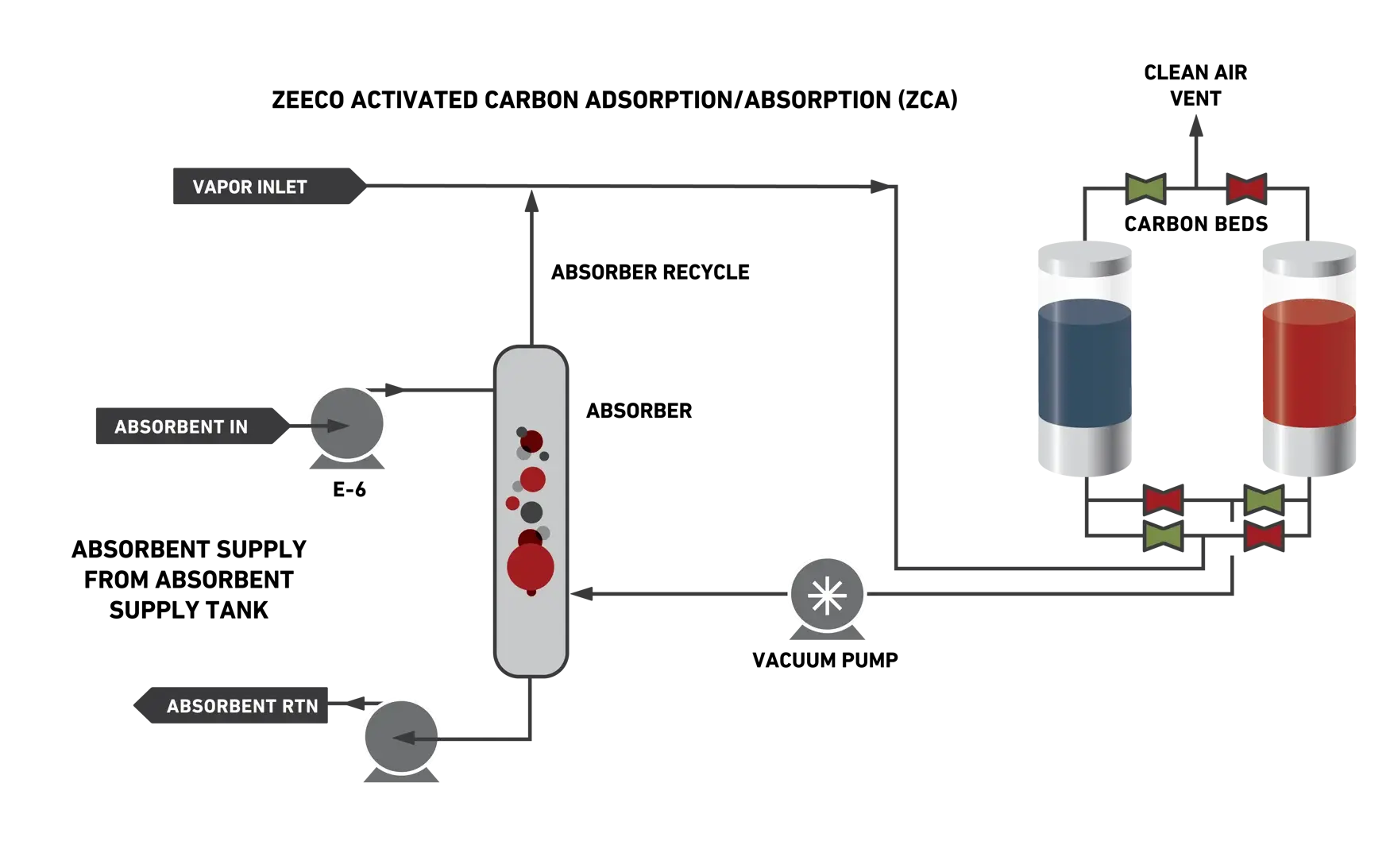
Zeeco vapour recovery units use activated carbon adsorption to capture hydrocarbons from a vapour stream. The recovered hydrocarbons are then separated from the carbon and returned to the loading operation or storage facility.
The process involves four main stages:
-
Vapour collection: Hydrocarbon vapours generated during storage or loading are collected and directed into the vapour recovery system instead of being vented to the atmosphere.
-
Activated carbon adsorption: The collected vapour stream passes through activated carbon, which adsorbs hydrocarbons and allows the system to capture recoverable compounds.
-
Vacuum regeneration: A vacuum pump system removes the adsorbed hydrocarbons from the activated carbon. Depending on the system design, Zeeco VRUs can use liquid ring, dry or sliding vane vacuum pumps.
-
Hydrocarbon recovery and return: The recovered hydrocarbons are re-absorbed into a circulating absorbent stream and returned to the loading operation or storage facility for reuse.
Activated carbon adsorption is an established technology for industrial vapour recovery. Zeeco's systems are designed to accommodate varying vapour flow rates and inlet hydrocarbon concentrations, with stated turndown capabilities ranging from 0% to 100% under applicable operating conditions.
Zeeco Vapour Recovery Systems Support Different Industrial Applications
Vapour recovery requirements vary depending on the facility, product being handled and volume of vapours generated. Zeeco offers systems with different vapour inlet capacities, from smaller truck-loading terminals to large marine-loading operations.
Common applications include:
- Storage tank facilities: Capture vapours associated with tank pressure management and storage operations.
- Truck-loading terminals: Recover hydrocarbon vapours displaced during product loading.
- Rail-loading facilities: Manage vapours generated during railcar loading and product transfer.
- Marine-loading terminals: Support vapour recovery during larger-scale ship-loading operations.
Zeeco engineers vapour recovery systems around application-specific flow rates, hydrocarbon concentrations and operating requirements.
Depending on the system configuration and application, Zeeco designs VRUs for emissions-control requirements ranging from 35 mg/L down to 1 mg/L. Actual performance depends on the vapour stream, equipment design and operating conditions.
Vapour Recovery Units Reduce Emissions and Recover Valuable Products
Capturing hydrocarbon vapours provides environmental and operational benefits beyond emissions control alone.
Key advantages include:
- Reduced emissions: Capture hydrocarbon vapours and VOCs that might otherwise be released during storage and loading.
- Product recovery: Return valuable hydrocarbons to the facility rather than losing them through venting or combustion.
- Environmental compliance: Support applicable emissions-control requirements for Canadian industrial facilities.
- Controlled vapour handling: Manage vapours through an engineered collection and recovery process.
- Potential economic return: Recovered products may help offset equipment and operating costs over time.
Zeeco VRUs can achieve hydrocarbon recovery rates of up to 99%, with approximately 1–2 litres of product recovered per 1,000 litres loaded.
Depending on product value, operating conditions and recovery volumes, some installations may achieve a return on investment within a few years. These figures are application-dependent rather than guaranteed results.
Typical Products Recovered
The products suitable for vapour recovery depend on vapour composition, operating conditions and system configuration. Zeeco systems can be engineered for a range of hydrocarbons and other recoverable compounds, including:
- Gasoline
- Crude oil
- Naphtha
- Condensates
- Benzene
- Xylenes
- Toluene
- Methanol
- Ethanol
- MTBE
- ETBE
Vapour Recovery and Vapour Combustion Address Different Operational Needs
Industrial facilities have several options for managing hydrocarbon vapours, including recovery, combustion and flaring.
A vapour recovery unit captures recoverable hydrocarbons and returns them for reuse. By comparison, a vapour combustor destroys combustible vapours through controlled combustion, while flaring manages combustible gases by burning them.
The appropriate technology depends on vapour composition, recovery potential, emissions objectives and facility requirements. Where vapours contain commercially valuable hydrocarbons, recovery may offer an opportunity to reduce emissions while retaining product value.
MICA also offers information on related
Selecting the Right Vapour Recovery Unit for Your Facility
Choosing a vapour recovery unit requires evaluating the facility's vapour stream, operating conditions and recovery objectives.
Important considerations include:
- Vapour inlet capacity: Expected flow rates and variations during loading or storage.
- Vapour composition: Hydrocarbon concentration and the compounds being recovered.
- Facility application: Storage tanks, truck loading, rail loading or marine loading.
- Emissions requirements: Applicable limits and desired recovery performance.
- Site conditions: Available infrastructure and operational constraints.
- System integration: Monitoring, automation and control requirements.
Because these factors influence system sizing and configuration, technical consultation is important when specifying a new VRU or upgrading an existing installation.
Frequently Asked Questions About Vapour Recovery Units
What is a vapour recovery unit?
A vapour recovery unit is an industrial system that captures hydrocarbon vapours generated during storage or loading and recovers valuable compounds for reuse rather than releasing them into the atmosphere.
How does a vapour recovery unit work?
Zeeco's activated carbon VRUs capture hydrocarbons through adsorption. A vacuum pump regenerates the carbon, and the recovered hydrocarbons are absorbed into a circulating liquid stream for return to the facility.
Where are vapour recovery units used?
Common applications include storage tank facilities and truck, rail and marine loading terminals where hydrocarbon vapours are generated during storage or product transfer.
What products can a vapour recovery unit recover?
Depending on system design and vapour composition, VRUs can recover products such as gasoline, crude oil, condensates, naphtha and various other hydrocarbon compounds.
How is vapour recovery different from flaring?
Vapour recovery captures hydrocarbons for reuse, while flaring burns combustible gases. The appropriate method depends on the vapour stream, emissions requirements and facility objectives.
Explore Zeeco Vapour Recovery Systems With MICA Technologies
Zeeco vapour recovery systems help industrial facilities manage hydrocarbon emissions while recovering valuable products from storage and loading operations.
With engineered configurations for different vapour inlet capacities and operating conditions, these systems can support a wide range of industrial recovery requirements.
MICA Technologies provides Canadian operators with access to Zeeco solutions and technical guidance for evaluating vapour recovery applications.
Contact MICA Technologies to discuss your facility's vapour recovery requirements.